Friday, February 24, 2012

Microstates : 18c MMM (fake)

MMM : More of Mister Mavrodi

I never tought I could write that much about 'fake' banknotes. But since I got my first Mavrodi banknote-look-a-like, I searched for more.

In my previous post, I posted all notes belonging to the first series.
Now I show you the second series.

After the first success of the biletov-notes (the notes actually represented parts of MMM shares), and the huge profits that seemed to be paid out to the first share holders, a new set was printed.
Now, the Pravda newspaper didn't mention 'biletovs' anymore in their reports, but called the vouchers 'shares'.

Again 100 biletov represented one share of the elaborating MMM company.

The 'notes' in the second set are not as uniform as those in the first set.
There are 4 notes known, but there might be more.
The first 'note' in this series came in 2 versions.

two 1 bilet 'notes' with a blue and a grey face of Mavrodi
back of the 1 bilet 'note' second version slightly darker
The higher denominations :
100, 1000 and 10000 biletov - front
100, 1000 and 10000 biletov -back
The security marks in this second set are less complicated then the first series.
(Maybe there was no time to make a 'decent' note at that time).


1. embedded fluorescent fibres in all notes
2. the 1-, 100- and 1000 notes carry a halo of fluorescent ink around the serial number
    the 10,000 note has a serial number that fluoresces green when submitted to ultra-violet light.
3. micro text
4. fluorescent MMM logo
5. decoration on the sides can not be felt (on the first series, this border is rough)

to be continued

Thursday, February 23, 2012

Microstates : 18b MMM (fake)

The Mavrodi investment system was based on shares. Like there are billions of shares on the stockmarket.
Those shares represented a certain part of the company.

Shares were devided into 100 parts, and each part, one-hundredth of an MMM share was called a 'ticket'.
The russian word for 'ticket' is bilet, and two or more are called 'biletov'.
The price of the shares was published in the russian newspaper 'Pravda'
The last advertised price for the original issue of biletov in Pravda was on 28 July 1994, when Mavrodi was trying to sustain the value of his shares. The MMM advertisement stated the day’s price for the biletov as 1,340 rubles (sell) and 1,250 rubles (buy), while projecting the price for 2 August to be 1,500 rubles (sell) and 1,350 rubles (buy).

This were the values of the first round, first series of biletov 'notes' who were issued in july 1994.

The 1 set has 7 banknote-like ‘notes’ going from one bilet to 1000 biletov (one-hundredth of an MMM share to 10 MMM shares).

1st series (1994)
1, 10 and 20 bilet(ov)
back of a 10 biletov, similar to 1 and 20
50, 100 and 500 biletov
back of a 500 biletov (similar to 50, 100 and 1000)
1000 biletov (10 MMM shares)
Although they aren't banknotes, some security features can be found on the notes :

1. embedded fluorescent fibres (1 and 10, 50 and 100 biletov)
2. micro-printing is used on all notes, repeating ‘MMMBILETOV’ in Russian


3. a yellow MMM logo appears to the right on the front of the note when the note is submitted to ultra-violet light. (1 to 100 biletov)


4. MMM logo turns pink under a UV light (500 and 1000 biletov)
5. serial number turns green under UV light (50, 100, 500 and 1000) as well as the prefix (500 and 1000)


6. gold, bronze and silver (50 to 1000 biletov)

to be continued...

Microstates : 18a MMM (fake)

Banknote collectors have encountered some banknotes that they can't always localise.
This goes for the MMM-notes of Sergi Mavrodi.
MMM-logo
MMM stands for : Sergei Mavrodi, his brother Vyacheslav Mavrodi, and Olga Melnikova.
Sergei Mavrodi
It all started around 1989, when the MMM's started a company that imported computers and office equipment. However, they were accused of tax evasion. He needed funds to finance his operations and switched to the financial sector. At first he was not successful at all.
Until  1994, when he created a 'succesful' Ponzi scheme.

A Ponzi scheme is a faudulent investment operation that pays returns to its investors from their own money or the money paid by subsequent investors, rather than from any actual profit earned by the individual or organization running the operation. It was named after Charles Ponzi a a jewish-Italian business man who used the technique for the first time on big scale in the 1920's in the United States.
 
Charles Ponzi after his arrestation
Ponzi however didn't invent it, since Charles Dickens's 1857 novel Little Dorrit already described such a scheme. Ponzi's operation took in so much money, that it became know throughout the States as the Ponzi's scheme.

In fact, it is quite similar to a pyramid game or pyramid scheme. Although there are differences.
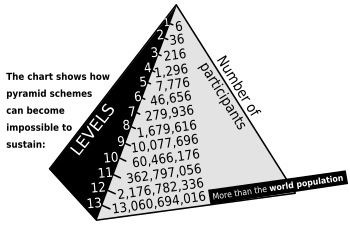
In a pyramid scheme, one has to find a number of people who want to join the scheme.
Imagine you have to find 6 participants.
Each of them have to give you something, one Euro, one Dollar, one token ...
So in your first action, you will get 6 Euro. Now the 6 people who are new in the game, have to search each of them 6 new people. They will give each of them 1 token, so the second generation will receive each 6 tokens, although the only invested 1 token to the 1st generation.
The second generation now has to look each of them for 6 new people... this involves already 216 people.

So far, not much 'damage' is done...
Imagine now that you don't get paid by the 'generation' that you generate, but you only get paid after 5, 6, 7, ... generations. The new generation pays the top person in the pyramid and take him off the list, so everyone moves up one generation.
Briefly said, if the scheme holds on for 5 generation, you'll get 7,776 tokens; if you are paid after 6 generations, you'll receive 46,656 tokes. Not bad for a 1 token investment.
However .... this involes already 46656 + 7776 + 1296 + 216 + 36 + 6 = 55980 people!
By the time the 6th generation has reached level one ... (and start to receive the tokens), already 2 billion 'new' people are needed and over 2,6 billion people are involved.


Chain letters are also an example of piramid schemes.

A ponzi scheme is slightly different.
As in the pyramid scheme you have to look for 'successors' yourself, the revenue is depending on the succes of the newly added participants.
In a ponzi scheme, you get a fixed percentage of profit and the "owner" is adding investors to the system.
As a small investor, you get a high profit, without having to do anything yourself.

If a pyramid game becomes 'impossible', a ponzi scheme in fact is just a rip-off.
Investors get paid with the investments of new contributors. Or with their own invested money.

MMM created its successful Ponzi scheme in 1994

They promised hughe profits to all investors within a short period of time. Profit rates of 1000% per month.
This led to an enormous rush to the MMM-banks who accepted the russian rubles in exchange for the MMM-shares (notes). At a certain moment, the company was taking in over 100 billion rubles A DAY !
(50 million USD). The cashflow was that enormous that money was no longer counted as money, but in 'rooms': 1 room of money, 2 rooms of money, ...

1 room of money ...
On July 22, 1994, the police closed the offices of MMM for tax evasion. For a few days the company attempted to continue the scheme, but soon ceased operations. At that point, Invest-Consulting, one of the company's subsidiaries, owed more than 50 billion rubles in taxes (USD 26 million), and MMM itself owed between 100 billion and 3 trillion rubles to the investors (from USD 50 million to USD 1.5 billion). In the aftermath at least 50 investors, having lost all of their money, committed suicide.

In August 1994 Mavrodi was arrested for tax evasion. However, he was soon elected to the Russian State Duma, with the support of the "deceived investors". He argued that the government, not MMM, was responsible for people losing their money, and promised to initiate a pay-back program. The amount ultimately paid back was minuscule compared to the amount owed.
In October 1995, the Duma cancelled Mavrodi's right to immunity as a deputy. In 1996, he tried to run for Russia's presidency, but most of the signatures he received were rejected. MMM declared bankruptcy on September 22, 1997.

He was placed under police custody in 2003, then was convicted of holding a fake passport and sentenced to 13 months in prison. While in custody he was also investigated over tax evasion and fraud charges that came to light in 1994 and 1995. Mavrodi tried to delay sentencing announcement of his criminal case. Court hearings on the fraud charges began in March 2006. On April 28, 2007, the Moscow court sentenced Mavrodi to four and a half years in a penal colony. The court also fined Mavrodi 10,000 rubles ($390).On May 22, 2007, Mavrodi left prison, serving full sentence.

In 2008 a similar fraude by a ponzi scheme was used by Bernard Madoff in the United States.
B. Madoff
In 2011 Mavrodi is back in business, having ideas for new MMM-investments, in Russia and Ukraine.

to be continued...

Wednesday, February 15, 2012

Odd stamps : 09c hologram stamps

One of my favourite countries to collect is surely Thailand.
Fair priced face value, high quality stamps and beautiful designs.

No wonder Thai Post emitted also holograpic stamps.

If you consider the hologram as the "grand cru" of printing, then only the highest is good enough to be depicted on the stamps.
For some countries this means "spacial" items, but for Thai, it can only be H.R.H. King Bhumibol (Rama IX).

In several series dedicated to the life and work of the Thai king, a special holograpic stamp is included in each set.
Thailand, the life of King Bhumibol
Thailand 1991 - detail hologram stamp
So far, only the King has been depicted on hologram stamps. So also with the next beautiful issue:

Although this sheet isn't really depicting the Thai king for a royal event, the king appears again on all stamps.
The sheet was issued in 2008, to commemorate 125 years fo Thai Postal Services.
As it was founded under Rama V (King Chulalongkorn), he is depicted on old stamps.
In the middle of the sheet, a hologram of the king.

Thailand full sheet 2008
Thailand detail hologram
Third and last item today, is again a sheet in honour of the life and work of King Bhumibol.
It's the second sheet in a series of stamps issued to celebrate the king's 80th birthday.

This sheet is seen in many Thai shops, on walls in private houses, ... in order to pay respect to the Thai king.
Respect also for the Thai postal services for the beautiful sheet.

Thailand full sheet 2007

Thailand detail hologram stamp + gold print

And there are more hologram stamps...

Odd stamps : 09b hologram stamps

There aren't many countries that have issued holographic stamps or stamps with holograms.
But with a little bit of research, you can still find lots of great stamps for your collection.

In this second post, some more holograms:

First item is a sheet from Finland.
The sheet has 3 stamps and a hologram.
Infact the hologram itself isn't a stamp, but if the sheet was used completely on a letter, it can be found as an postally used philatelic item.

What's more special albout this sheet, is that it is cut like a "tangram" a game with 7 geometric shapes, put together as a square. Each of the single shapes can be formed by putting the other shapes in a certain order.
Also other forms can be made by putting each piece in another place.
A nice game and major brain-breaker.

Finland sheet with hologram

Finland - detail of the hologram
Another European country that has used holograms on stamps, is Germany.
In this set, dedicated to scientific discoveries, several stamps were decorated with holograms.


Two German semi-postal stamps on space science

Jupiter encountered by a comet
map of the sky, seen under gammalight

Science doesn't have to be boring as you see...

Tuesday, February 14, 2012

Odd stamps : 09a hologram stamps

Time for some new odd stamps.
You see it often in banknotes and certificates, holograms are used as a security mark
Official software is secured with holograms, but in stamps it's not that common.

Holograms used in euro money
There are not many holographic stamps or stamps with a hologram.


Such a security mark is not really necessary for stamps and mostly the value of a stamp is too low to invest in such a marks.
The only reason for holograms on stamps, is to "show off", to have a "special issue"...
Briefly, to make collectors pay extra.
But it's a given fact, holograms are attractive.

A hologram is a word with greek roots : holograph : hólos (the whole) and graphein (to write, to draw).
So it's a way to write print a whole image.

What is a hologram in fact?
It's not easy to describe it in an easy way, but let's try.

When looking through a window, all waves coming from the window to the retina in your eye. The combination of those waves make us see a 3D image.
Using certain optical (and physical) techniques, a 'photograph' can be made of a certain moment in this cyclus of waves. The image itself is not 3D, but with the use of light (or laserlight) the 'idea' of waves can be reconstructed.
When waves comes from different directions, the 3D image becomes more realistic and 'deeper';
In a hologram, the natural light is reconstructed and gives us the 3D view again.
The larger the holgram is, the bettter the 3D effect and the 'deeper' the view becomes.

The Hungarian scientist Dennis Gabor discovered the basic idea for holograms in 1948, but it lastet till 1960 until the first hologram was made, by the Americas Upatnieks and Leith. Gabor received the Nobelprice for his discovery, in 1971.

So far the theory, now the stamps ...

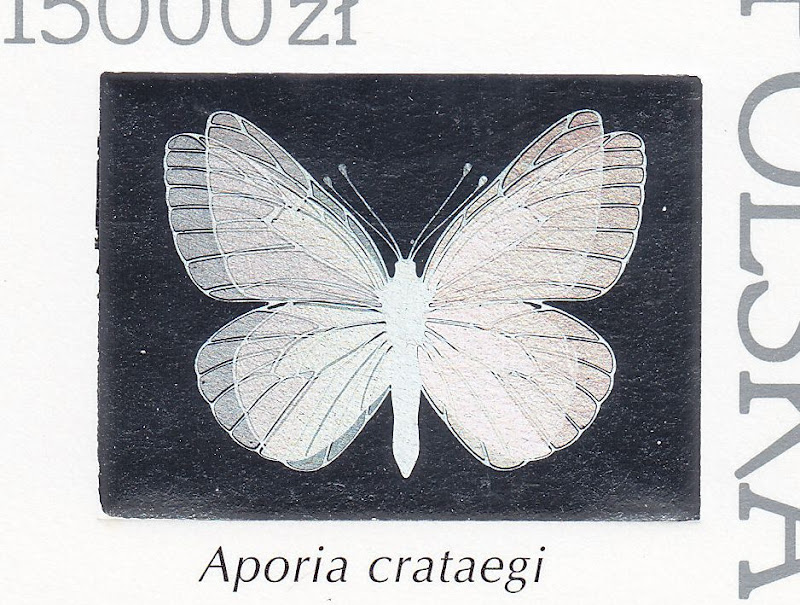
First sheet is from Poland, a sheet with 2 stamps, one with a hologram of a butterfly.
Poland holographic butterfly

Poland detail hologram

Secondly Bhutan, a lot can be said about Bhutani stamps, but they have been a pioneer in emitting special stamps. This is a sheet to commemorate the 25th anniversary of Man' first step on the Moon.

Bhutan 2 hologram in one sheet

Bhutan detail hologram


There are more holographic stamps to follow

Sunday, February 12, 2012

To be or not to be : CTO - The dangerous ones 05 c

The obvious way for stamps to become CTO, is a genuine stamp that gets cancelled by officials, companies or postal services, to prevent they get used, or sold.
That sounds very logic.
Some CTO stamps are printed with cancel at the same moment the stamp itself gets printed.

But can it be the other way around too?
Can a CTO cancelled stamp become a genuine, postally used stamp again?
"No" seems to be the only logic answer, unless you remove the cancellation of course.
I don't know if that is technically possible, maybe it is, but that's not my cup of tea.

So can a CTO stamp still become a postally used one....
Well to my surprise my Malaysian friend helped me to solve that mistery!

Let's show a picture of a sheet I posted earlier :

CTO cancelled sheet from Malaysia
Back of the sheet, showing it's CTO cancelled
The letter I got from my friend K.M.

detail of the cancel
Now let's have a closer look at this postally used cancel.
There are a awful lot of cancels for just one corner, don't you agree...

First I marked the real cancels (highlighted in red) with the cancellation date underlined  18.1.12

real cancels

 Secondly a large cancellation in the middle, showing a date somewhere in April

Original CTO cancel (older then the postally used one)
As far as I know, the 'used' sheet was clearly cancelled to mask the original cancellation.
My friend told me that was the only way to get me such a sheet, postally used.
But since this cancel was made on demand of my friend, it becomes again a CTO, or not?

Anyhow, I'm very lucky to have this special sheet now, and thankful for the effort he made to get me the sheet.

Thursday, February 2, 2012

Currency Today : Kenya 02

More about Kenya.
I posted the coins before, and want to show some of the banknotes currently in use (2012).

In Kenya banknotes of 50, 100, 200, 500 and 1000 shilling are in use.
1000 Kenyan Shilling is at this moment more or less 12 USD / 9 EUR.

The design of the notes are mainly the same. On the front we see the face of Jomo Kenyatta.
Kenyatta was prime minister after the independency in 1963 and became the first president when Kenya became a republic in 1964. He remained president until his death in 1978. He is considered the founding father of Kenya.
Many schools, hospitals, two universities, numerous streets and even the national airport is named after Jomo Kenyatta.
In the future however, his face might dissapear from Kenyan notes, as the new constitution decided that there should no longer be portraits of persons on any of Kenya's banknotes.

50 Kenyan Shilling (front)
50 Kenyan Shilling (back)
2 different printing dates
100 Kenyan Shilling (front)
100 Kenyan Shilling (back)
200 Kenyan Shilling (front)
200 Kenyan Shilling (back)

 to be continued ...

Wednesday, February 1, 2012

Currency Today : Kenya 01

To avoid too many subthemes, I'm planning some posts on coins and banknotes that are in use right now. As there are few places were only coins or only banknotes are in use (like Laos for example), I decided to combine both notes and coins under the title 'Currency Today'.
If my blog survives the end of the world in December 2012, and if it's still online in 2062, there might be some updates needed, but so far I'll keep the title, "Currency Today".

As the whole northern hemisphere is suffering from cold, there's no better place to go then the hot and wonderful Kenya.
Another reason why I'm posting Kenya currency now, is because a friend of mine, just came back from the eastern african country, with some fine coins and notes.

map of Africa - Kenya

Kenya is a country that is known by the Arabs since the 8th century, for the ivory and slave trade.
The Portuguese took over influence in the 16th century. The small island of Zanzibar near the Kenyan and Tanzanian border controlled much of the eastern side of Africa and because of it's strategic position on the way to India, also the German and British conquerors were mostly interested in Kenyan harbours.
Since Dec. 12, 1963 the country is independent and since 1964 it's a republic.

As a result of British influence, the currency is Cent and Shilling.

Kenya currency (front) - 2012
Kenya currency (back) - 2012
Most of the coins are bimetallic coins.

In use are 1, 5 10 and 20 shilling coins.
Less common is the 40 shilling bimetallic coin.
It's less common not only for it's face value of 40, but the first banknote in use is a 50 shilling note.

A closer look at the coin explains a lot.
Since the country became independent in 1963, the coin is actually a commemorative coin to celebrate the 40th anniversary of the independence.  No better reason to emit a 40 shilling coin of course.

40 shilling Keny - commemorative coin 2003
Maybe in 2013, a new 50 Shilling coin will be issued.


to be continued...