Saturday, July 23, 2016

Emergency Money - B 1914 - 1920 - 01 Belgium - Introduction 2

In order to have an idea of the value of some emergency notes, and of currency in 1914 in general, we need to know what the average costs of basic products were, as well as the income of a henchman, a factory worker, an independent worker ...

In 1914, a henchmen who could eat at work, earned about 1 belgian frank a day.
If food was not included, he gained 2 franks a day. A worker in a factory earned about 3 franks a day, and if you were an independent worker, you could earn up to 4 franks a day.

1 belgian franc (french version) 1914
To give an estimation of the value: in 1914, 1 franc equals 3 euro (3.2 USD) - in 1919 the same franc is only worth 1.9 euro (2 USD).

Secondly it's important to know the prices of most articles.

Shortly before the start of the First World War, sole (fish) was sold around 180-200 francs per lot. Turbot (fish) was sold at 3,50 francs a kilogam.
On the day the first World War started in Belgium, sole went down to 36 franks per lot, turbot to 0.20 franks a kilogram... This resulted in tons of rotting fish in the belgian harbour of Ostend.
On the other hand, that same day, potatoes went from 1 franc per 10 kg in the morning, to 1.6 francs in the evening.

In this table, a short overview of the prices (in Belgian francs) during the First World War:
evolution of prices during WWI in belgian francs
It is clear that the income of most people in Belgium - and most countries affected by the First World War, was insufficient to survive.
Thanks to the different commitees, and social organisations, this income was raised thanks to the emergency notes (coupons) that were distributed.
One of those committees at a certain moment gave support to people as follows :
3 francs for an adult man - 1.50 francs for an adult woman and 0.50 francs per child.
I could not find out if this was per week or per month.

To give at least one meal per day to its citizens, many cities organised free soup distribution among their citizens.  This was for many the one and only meal they had per day.

free soup distribution WWI
to be continued ....

Friday, July 22, 2016

Emergency Money - B 1914 - 1920 - 01 Belgium - Introduction 1

When talking about 'Notgeld' or 'Emergency Money', you might think that this is a typical phenomenon for Germany. When googling "Notgeld", you will encounter the fancy German notes first.
It wouldn't be me, if I wouldn't start with another country of course.
Belgian Notgeld Catalogue (cover)
During the first World War, Belgian lacked coins for daily use. The war industry needed metals in all kind of ways. Around 600 cities and city boards, as well as hundreds of welfare organisations, agreed on producing 'emergency currency'. Paper or cardboard was used, and in some cases also (cheap) metals.
In the beginning this 'money' was ment to pay out soldiers, to pay loans of city workers, suppliers of the city... But later on, it was accepted to cope with the lack of coins for daily use. Often, those coins or paper coins/tokens, were restricted in use. One could buy clothes, or coal, but not food... or the other way around.
Along with city boards, a lot of social organisations, like the "national committee for aid and nutrition", issued similar coupons.
Even some factories issued coupons to pay out their employees. Many of those coupons were to be exchanged in stores owned by the same factory...

In much cases, the coupons or emergency currency was only valid within the city that issued the notes. Often there was a date printed on the notes, which told the owner on what day the note could be exchanged for "real" money again, or in some cases, to be exchanged for another coupon.

As a guideline to the Belgian 'emergency issues', a highly recommended catalogue is available.
Prices varie between € 40 and € 90.

Belgian Notgeld catalogue - details 1

Belgian Notgeld catalogue - details 2
A - basic - online catalogue (without prices) can be found on :
http://www.nbbmuseum.be/catalogs/necessity/start_fr.htm (french version)
http://www.nbbmuseum.be/catalogs/necessity/start_nl.htm (dutch version)

to be continued ...

Thursday, July 21, 2016

Emergency money - A Introducion 02

There is so much to say about Emergency Money - and in extention about replacement coupons - that a bit of a guidline might be useful.

To make a difference with 'banknotes', let's state that banknotes are issued by the National Bank of a country (or a group of countries), notes that are issued by the National Mint of a certain country, or by a government ruling a certain area on a certain moment.
In this set of articles on Emergency (and replacement money), we talk about notes/coins and coupons that are issued by private organisations, non-profit organisations, cities, towns, ... in order
a) to replace coins or notes because there's a shortage of official coins/notes
b) to support the poorest - victims of war, to enable them to buy specific goods (coupons)
c) to replace national currency because of heavy inflation
d) to replace national currency to avoid national currency leaving the country (tourist currency)

e) to replace national currency to give a number of people access to other products (like for military, foreigners, ....)

f) to pay employees in a way that they were forced to use their 'money' to spend in shops owned by the company that issued the 'money' - Nazi concentration camp 'money' is a similar type of money.

I might have forgotten some categories, but at least we're more or less clear about the difference with bank notes.

Not in this category are the French, British, Russian 'assignats' - although they were replacing silver and gold coins as well. They were a stage between the use of gold/silver towards the use of banknotes as a general way of making payments.
Besides that, they are in all 'banknote' catalogues, so they can be considered as 'banknotes'.
Tokens issued on fancy fair, casinos and in certain theme parks (Disneyland) are other types of 'replacement money' and are left out of this list too.

In what follows, I will try to pay attention to the following themes :

A (was introduction)
B : for Emergency Money issued at the beginning of WWI
C : "Grossgeld" - emergency money for higher values than the usual circulation coins
D : "Serienscheine" - the 'fancy' Notgeld issues of (mainly) Germany in the 1920's
E : Inflation money
F : Inflation-proof money
G : Military money - Prisoners money - War Occupation money
H : Coupons other then the WWI coupons
I : Tourist money


check previous items and more to follow ....
contributions are welcome

Emergency money - A Introducion 01

From the beginning of the first world war, a shortage of metals forced a lot of countries to redraw their coins out of circulation. Silver coins were too valuable but also other metals were needed for war industry.

To cope with the demand of small denominations, lots of cities started to issue paper notes to replace the needed coins - some coins were issued in zinc or other cheap metals, and even other material was used, linen, silk or velvet, porcelain, leather, ... you name it.
This happened in many countries, Belgium, France, Germany, Austria ...

This 'emergency money' was roughly issued beween the beginning of the first World War, till the beginning of the second World War.

The first issues, in Belgium, France, ... were issued by different authorities, cities, non-profit organisations, employment offices, social organisations, ... in order to supply funds for the people suffering from the economical situation during the first world war.
This means that the issued notes were not only as a replacement for real 'money', sometimes they were also coupons that could be exchanged for grain, bread, meat, fish, ...
In this vieuw, we can add a whole category or chinese food coupons to this already elaborate theme.
And China is/was not the only country issuing food coupons.


Many of later notes (especially in Germany) became very fashionable and were issued for reasons beyond the need of real 'money'. They can be considered in a way as cinderellas.
These notes are known as 'Serien Scheine" - some special series, issued by a number of cities are know as "Reutergeld".

Later issues (for example in the 90's of previous century) were issued mainly to fight inflation in areas that suffered from war, like Bosnia Hezegovina. Here we find mostly paper notes.

In order not to make this introduction too complicated, I will leave it here.
There are thousands and thousands of different notes and coins.
Hopefully i'll find a way to make it understandable for you all....

(contributions are welcome!)
to be continued...

Tuesday, June 21, 2016

Odd stamps : 09f hologram stamps

Another - small - contribution to the hologram stamps, goes back to 1999.
The Netherlands issued 2 stamps to honour or promote stamps and stamp collecting.

Set of two stamps of the Netherlands
2 stamps were issued on the topic 'I love stamps' and 'Stamps love me'.
Twice is the word 'LOVE' replaced by a hologram that alternates the words 'LOVE' with heart symbols.
LOVE alternated with ♥♥♥♥
The colours are red, white and blue. And although the stamps look very 'American' to me, they are also the colours of the Dutch flag.

more to follow...

Friday, June 10, 2016

Microstates : 18d MMM (fake)

Somehow it's a pity to waste much time and effort to a fake set of notes, such as the (in)famous Mavrodi biletovs.
However I noticed something so remarkable not so long ago, that I didn't want to hold it back.

In fact, this small article has nothing to do with the previous articles I wrote on Mavrodi's MMM bank shares. And yet, it's a nice way to complete this set of articles.

First of all I have to say tell you that in Belgium (where I live), since a couple of years, the licence plates were renewed.
Since we were running out of combinations with 3 letters and 3 numbers. A new digit was added to the official licence plates. New plates look like "1-ABC-123"
belgian licence plate new style
Together with this is was possible to request a private plate, which started with a 9-.........
However, the system was very successful, and although a private licence plate costed € 1000 each, the demand increased. 
Ok, now comes the funny part.... excluded combinations were 'numbers alone' as they are used for the royal family....
A lot of cars were fined in France for speeding, but the French authorities didn't have the means yet to identify the new belgian licence plates, and could only read 1 - ...... which happens to be the licence plate of our King.....
At the beginning a lot of speeding tickets were sent to the belgian royals...

belgian licence plate of the royal family
One problem solved now.
After a while, the possibility to have any possible combination, replaced the 'old' 9-...... plates, and any combination of 8 digits was possible. (Those plates cost € 2000 ! each).
Again, no offensive names, or numbers alone, or politically inspired names were alowed.
For the rest ...
private plate with one digit
private plate with 6 digits
private plate with 7 digits
And finally.... to come where I started the article ...
This car stopped in front of me at the trafic lights :
MMM - licence plate (Belgium)
I wonder if the car owner is aware of the MMM-banknotes, but if not, he's popluar now.

Wednesday, June 8, 2016

Odd stamps : 01g Perfumed stamps

According a song, there is an awful lot of coffee in Brazil.
Aparently that much, that there is enough to add fragrance to a stamp issued in 2001.

The stamp shows coffee in 3 varieties.

Brazil coffee stamp 2001

We see on top the coffee as a bean. Cofee beans are red (or green) and become dark after being roasted, s hown on the right hand side of the stamp.
Finally a cup of fresh coffee is added to the design.
coffee beans
roasted coffee beans
I found some useful information on the word 'Coffee' on the internet.


The word "coffee" entered the English language in 1582 via the Dutch koffie, borrowed from the Turkish kahve, in turn borrowed from the Arabic qahwah ( قهوة).
The word qahwah originally referred to a type of wine, whose etymology is given by Arab lexicographers as deriving from the verb qahā (قها, "to lack hunger") in reference to the drink's reputation as an appetite suppressant. The word qahwah is sometimes alternatively traced to the Arabic quwwa ("power, energy"), or to Kaffa, a medieval kingdom in Ethiopia whence the plant was exported to Arabia. These etymologies for qahwah have all been disputed, however. The name qahwah is not used for the berry or plant (the products of the region), which are known in Arabic as bunn and in Oromo as būn. Semitic had a root qhh "dark color", which became a natural designation for the beverage. According to this analysis, the feminine form qahwah (also meaning "dark in color, dull(ing), dry, sour") was likely chosen to parallel the feminine khamr (خمر, "wine"), and originally meant "the dark one" ... thanks Mr. Wikipedia.

The stamp of Brazil has a certain fragrance, but honestly ... it smells more like roasted paper then coffee. Of course, the stamp was issued quite a long time ago, and the fragrance might have vaporised already. I'm a huge coffee drinker, but this smell is so to say ... not my cup of tea.


Coffee art


Tuesday, June 7, 2016

Odd stamps : 01f Perfumed stamps

Two things are forever ... Diamonds and... Strawberry Fields!
So far I have no stamps with diamonds so you'll have to do it with strawberry fields.
Well almost ...

In 2011, la Poste (the French postal services) emitted a sheetlet, to honour 'stamps'.
"Fête du Timbre" can be translated as "Stamp Feast".

France 2011 - fête du timbre

The stamp shows a beautiful complete strawberry, while on the side of the sheet, a devided strawberry is depiced, as well as the outlines of a strawberry plant.

A special extra can be found on the back side of the stamp, as the printing is partly repeated on the back side.
France 2011 - fête du timbre - back
Next to a barcode, we see a mirrored image of the full (and half) strawberry on front.
As if two sliced strawberries are depicted, one with the full side towards the front, one towards the backside.

The most remarkable however is the smell of strawberries!

When we take a closer look at the back side of the sheetlet, we see two zones with different printing.
the light blue line (top) shows where the gum is added.
The dark blue line (lower) indicates a zone with fragrance.

Stamps like this are a pleasure to have in your collection, unfortunately the fragrance will dissapear after a while, unless you keep the sheetlet in a sealed environment.

After all ... only two things are forever... diamonds and strawberry fields ;-)

Monday, June 6, 2016

Odd stamps : 09e hologram stamps

Stamps with holograms aren't issued that often, but Finland issued twice such a set within a couple of years.
The first set I present, was issued in 1992 and represents 3 stamps on technology ande research, european cooperation and Finnish patents.

The background of the stamp's design is rather dull, wires, lines and a machine.
The hologram on the stamp (identical on the three stamps) shows a group of trees, a river and some buildings on the background. Also the letters K.K. apear in the hologram.
Hologram


A second set of hologram stamps were also issued in Finland, but in 1995.
A booklet of 8 stamps to promote letter writing.

cover of the booklet
The stamps show scenes of letter writing, or postal delivery, through funny animals.
Each of the 8 stamps has a different hologram, showing an animal in a heart shaped background.

booklet of 8 stamps with holograms

stamp 1 - 4
stamp 5 - 8

one of the 8 holograms

Again a nice addition to my collection, and a reason more to start (or continuing) collecting.

Wednesday, April 27, 2016

Odd stamps : 06 j Stamps on cotton / silk

Canada is said to be the only country in the world that everyone wants to visit.
From the Norsemen in the 10th century over the French and British colonies in the 15th century, Canada has always been in the interest of many people.
Except for the border with the United States, which is the world's longest land border, Canada has no other neighbouring countries.
It is the second-largest country by area, and the fourth-largest country by land in the world.

But is it a country?
Before I get e-mails and letters from 36 million people in Canada, (don't worry, I speak both English and French), the question is not that odd.
Canada is a sovereign state, but with no president. Technically spoken, it is a constitutional monarchy under the British trone. Not only is the Queen represented on all Canadian banknotes, also the royal anthem is still 'God save the Queen' and the Union Jack (flag of the United Kingdom (of Great Britain and Norhtern Ireland) is still the Canadian Royal Union Flag...

De facto however, Canada is as sovereign as most other countries in the world.
Despite of the die-hard royalist, most Canadians consider themselves as idependent from their European motherland.

The flag and the anthem issue are solved as well.
The anthem "O, Canada" - although composed in 1880 - was adopted in 1980. It is used as national athem on official occasions.
The flag is a different story...
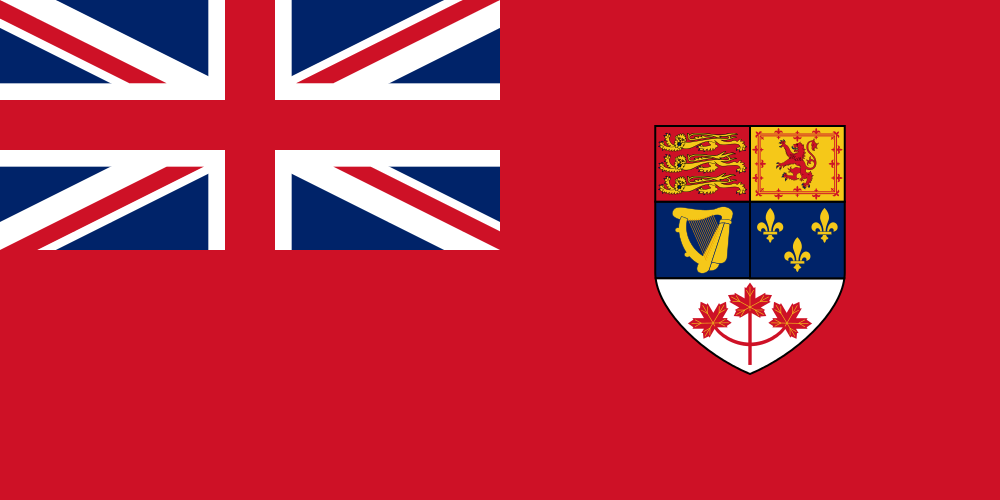
From the 19th century on, the Union Jack was present in the corner of the flag of Canada,
Flag of Canada 1868 - 1921
In the renewed design of 1921, the flag did not change much.
Flag of Canada 1921 - 1957
The Maple Leaf (symbol of Canada) is in green - and the Union Jack is in the corner.
In 1957 a small change was made in the design of 1921.
Flag of Canada 1957 - 1965
This minor modification, show the Maple Leaf in red. also the harp (Norhtern Ireland) is modernised.
The flag was only in use for a couple of years.

Finally, in 1964, a competition was held, to make a design for a new Canadian flag.
One of the designs that didn't win, showed the original colours of the Union Jack (blue, white and red) and the Maple Leaf, as it appeared on the previous flags.
1964 design : the Pearson Pennant
The winner of the competition, Colonel George F.G. Stanley had this similar flag, in only red and white. The flag is know as the Maple Leaf.
George F. G. Stanley 1907 - 2002 and his wife

Flag of Canada 1965 -
In 2015, Canada celebrated the 50th anniversary of its own flag, with a souvenir sheet, printed on silk. The image of the Maple Leaf therefore feels like a real flag.
Souvenir sheet of Canada 2015
The actual stamp is the flag itself (although hard to see) is self-adhesive.

The arrows shows where the perforation of the stamp is most visible.

Once more, Canada has issued a beautiful stamp which I thankfully add to my collection of odd stamps.

This article is dedicated to John Ridsdel (1948-2016)