After my previous post on money-wallpapers, I wanted to add some extra.
Maybe they will be on your desktop soon.
All images are free to use - to my knowledge.


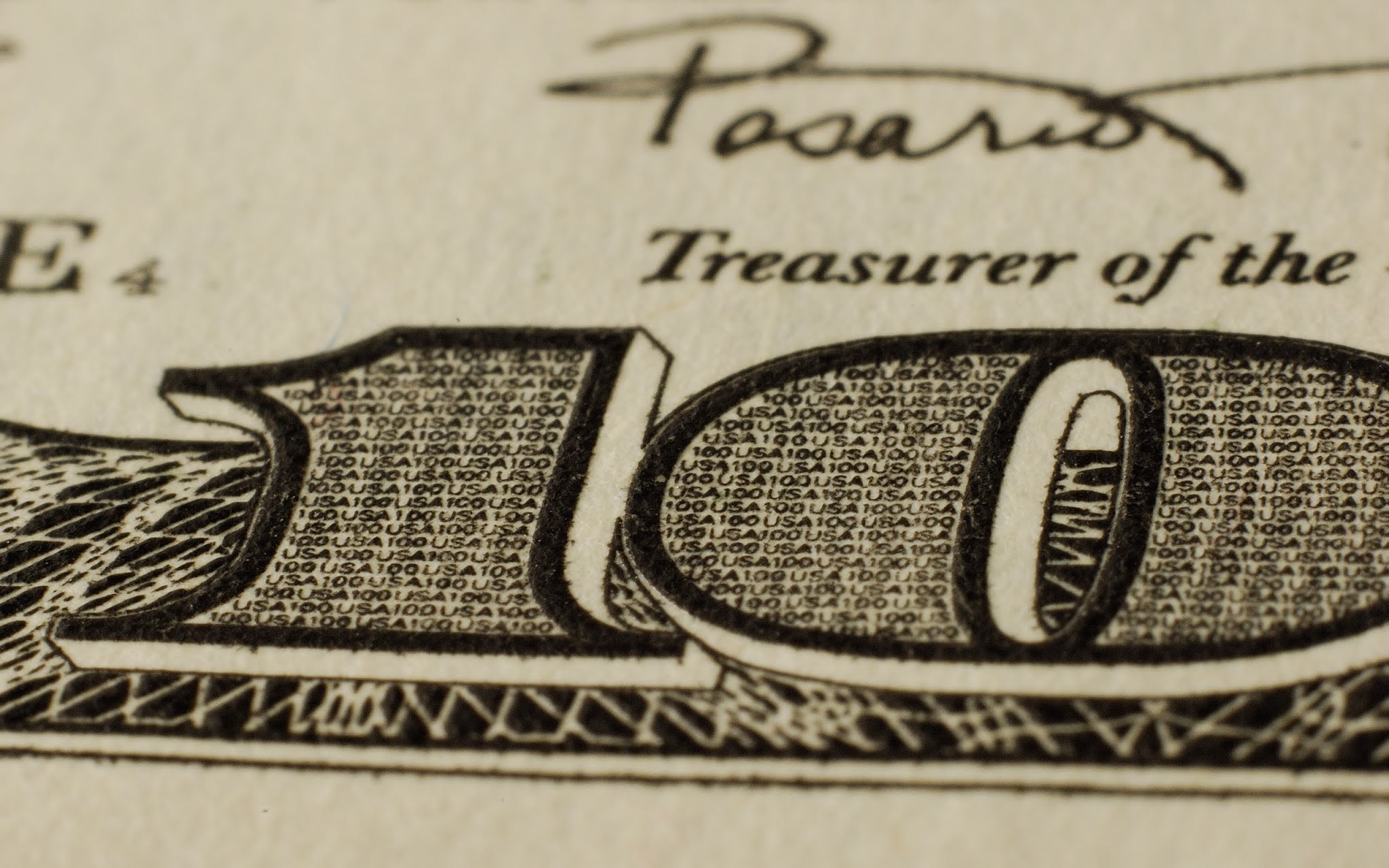
After my previous post on money-wallpapers, I wanted to add some extra.
Maybe they will be on your desktop soon.
All images are free to use - to my knowledge.
It took me a while, but finally I was able to find the complete set of the alphabet, used in Colombia.
The alphabet is the same as in all Spanish-speaking countries, and is the standard Latin alphabet, extended with some additional characters.
I could call it the 'Spanish' alphabet, but since the stamps are issued in Colombia, I'll name it the 'Colombian alphabet'.
The set consists of 30 stamps; 29 with characters and one with the message 'Learn to write'.
The set comes in 3 rows of 10 stamps each.
 |
| 30 stamps on the 'Colombian alphabet' |
 |
| A for Águila, B for Búfalo, C for Cóndor |

The 'CH' is considered a separate consonant, written with two letters
C+H. The word 'chimpancé' is pronounced the same as in English.
Also the 'LL' is unknown in the English alphabet. In Spain it will be pronounced as 'lj' but in South America 'sj' is a more common way to pronounce the 'LL'.
If the animal is named 'lama' you could say in Spanish : la llama se llama Llama...
 |
| N and Ñ |
Also typical for the Colombian (Spanish) alphabet is the 'Ñ' which we see in the country name 'España'. Because the 'ñ' is so typical for the alphabet, it is nowadays used on spanish stamps as a security mark.
The 'ñ' is cut out of many stamps as a security mark.
 |
| the 'ñ' cut out of the stamp |
The full set of 30 stamps has been given a catalogue value of € 30, about $ 1 each.
to be continued...
After many years of cooperation on economical, cultural and legislational matters, the end of the 20th century meant the introduction of a new currency in the mayor parts of the European area.
In 1999 euro was officially introduced as a new currency, but it lasted till 2002 until the coins and banknotes were actually put in circulation.
As a way to say 'goodbye' to the old national currencies, and a 'welcome' to the new notes, a lot of promotion was made. Informational posters with explanation on the new currency, as well as toy money for the kids to practise.
France issued some specimen notes, using the same sizes and colours as the the soon-to-be notes.
In a set of 8 notes, the mayor countries that started using the euro, were presented.
 |
| promotional material for the EURO currency |
5-euro:
On the 5-euro, all (last) Italian notes in lira are shown
 |
| 5 euro detail (Italy) |
 |
| 10 euro detail (Portugal) |
The 20-euro note depicts the last issue of the Spanish peseta notes
 |
| 20 euro detail (Spain) |
 |
| 50 euro detail (The Netherlands) |
100-euro:
Here we find the last notes issued in Belgian francs
 |
| 100 euro detail (Belgium) |
 |
| 200 euro detail (Germany) |
 |
| 500 euro detail (France) |
On the reverse side of the 'notes', we see all 12 flags of the intitial countries, forming the European monetary union (as well as two European flags with the Euro-sign.
 |
| reverse side of the promotional notes |
 |
| detail of the reverse side of the 'notes' |
Althoug this is (was) promotional material, these notes are offered on various vending sites, and prices vary from 1 - 2 USD / EURO per note.
For a full set, about 10 $ / € is asked.
Walking down from the trainstation in Antwerp (Belgium) trough the main shoppingstreet, towards the market square with the cathedral (see : https://rainbowstampsandcoins.blogspot.com/2020/07/0-euro-notes-1-f-belgium-antwerp.html), a hidden treasure can be found.
Like all mayor cities, Antwerp had a big event hall in the centre, to host meetings, concerts, ...
The 'stadsfeestzaal' (city party hall) was a monumental project to glorify the appearance of Antwerp at the end of the 19th century. It took about 8 years and 400,000 belgian francs (app. 10,000 euro nowadays), to complete the majestic hall.
 |
| 'Stadsfeestzaal' in 1908 |
This pearl in the heart of Antwerp, was used as event hall, concert hall, .... throughout the years. In the last days of the 20th century, an urgent upgrade and renovation was mandatory.
Although the 'stadsfeestzaal' survived two world wars, renovation works turned out to be a greater trial, as the hall set fire in december 2000.
The inferno destroyed nearly the whole place, and only the exterior walls and the metal roof construction survived.
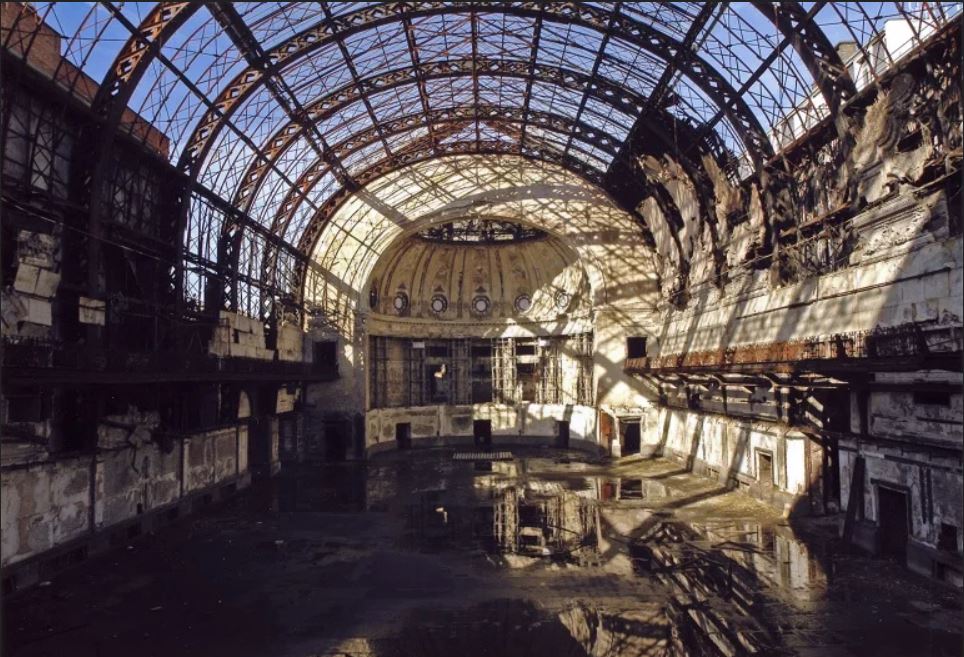 |
| 'Stadsfeestzaal' in 2001 |
But aren't the belgians the bravest of all the gauls.... The planned renovation works took longer than foreseen, and no expense was spared to return the hall into its former glory.
 |
| 'Stadsfeestzaal' in 2006 |
The result of the restauration works, was shown to the people in 2007, when the renewed 'feestzaal' was inaugurated again. The sides on the ground floor were turned into fancy shops and the balcony on the first floor became a walkway to newly created shops.
 |
| 'Stadsfeestzaal' in 2020 |
In 2021, a 0-euro note was issued to commemorate the 'stadsfeestzaal'. The amazing interior however, is not depiced, but we see the - original - entrance gate at the 'Meir-street'.
 |
| Entrance of the 'stadsfeestzaal' (Meir) |
 |
| 0-euro note 'Stadsfeestzaal' |
 |
| 0-euro note 'stadsfeestzaal' - detail |
The design of this note ( + common design on the back side) - has some new features, compared to the 'older' notes.

The 2021-note has 5 stars on the right hand side, and the watermark is visually printed in the left corner.
Additional text is added on both left and right side border 'Euro Souvenir'.
On the back side, the € - sign is slightly lighter printed, but the Belem tower, the Brandenburger Tower and the Colloseum, are printed more clearly.
A remarkable change is the statue of 'Manneke Pis' which turned from purple to olive brown.
 |
| some changes in the 2021 - design |
As a kid, I travelled to London with school, I remember in the old days, we visited the usual tourist attractions, and near the entrance of most buildings, there was the possibility to buy a souvenir coin of that specific building.
Many years later, I still have those 'medals' and some of them shifted colour over the years.
Those items are not that fancy anymore, and in the end also heavy and big to collect.
The 0-euro notes remind me of that time.
I'm still a collector and the wide variety of 0-euro notes, and the availability of a catalogue, makes collecting fun again.
Today's topic is about Antwerp (or Antwerpen in dutch). A Belgian city in the flemish (dutch speaking area of Belgium). Antwerp is know as one of the largest harbour cities in Europe, it's diamond industry, and his rich history, especially in the 17th and 18th century.
It is the home city of Pieter Paul Rubens, the famous baroque painter.
The first 0 € note of today, represents the square 'Groenplaats' near the cathedral.
Although the note is titled 'Cathedral of Our Lady', the central image on the note, is the statue of P.P. Rubens.
 | |
| 0 euro note 'Cathedral of Antwerp' |
Rubens was born in Siegen (Germany in 1577) and moved to Antwerp where he also died in 1640.
A bit odd is the date mentionned on the top of the note : 'anno 1518'.
 |
| Antwerp anno 1518 ? |
The cathedral as depicted, was finished around 1521. In 1518 the square might have looked like depicted, but at that time, Rubens was not born yet. The date can refer to the cathedral at that time, but certainly not to the square view in 1518.
Rubens is world wide know for his paintings of religious scenes, but as well for his portraits.
He often depicted volumtious women, a sign of wealth and beauty at that time. Also famous, is his 'selfie', or auto-portrait, with wide hat.


Rubens auto-portrait, on various stamps.
The cathedral was ment to have two towers, but the plans of 1565 were never executed. A fire in 1533 and the costs for the renovation, as wel as the rise of protestantism, which led to less income for the church, resulted that the secodnd tower never was built.
 |
| plans for a second tower 1565 |
 |
| Cathedral now |
to be continued ...
More plate flaws can be found on the stamps of the Claudio Gay's pictures.
The next one can be found in positions 81 and 86.

The right border frame is broken and a coloured spot covers the ornaments.
 |
| plate flaw pos 81-86 detail |
 |
| Loxodon Chilensis |
to be continued...
Another plate flaw on the 2.60 pesos issue of the Chilean stamps after Claudio Gay's designs, can be found on the 5th and 10th stamp. The 55th and 60th stamps on the full sheet, don't have these plate flaws.
 |
| plate flaw on position 5 and 10 |
The left border of the frame with the central image, is split, due to a white spot next to the frame.
The 'normal' version (other values and 2.60 position 55 and 60) don't have this error.
 |
| plate flaw 5 / 10 detail |
to be continued...
The Columba Araucana or Patagioenas Araucana, more commonly known as the Chilean Pigeon, is depicted on position 3, 8, 53 and 58 of each of the 3 sets of 25 stamps.
For the 2.60 Pesos - value, there is a plate flow on position 3 and 8:
 |
| couple of pigeons with plate flaw pos 3 and 8 |
 |
| deformed T in Santiago and damaged frame |
 |
| detail of plate flaw |
The depicted birds on the stamps, are Chilean pigeons. This bird is quite common in Chile.
 |
| Chilean Pigeon |
to be continued...
Errors on the 2.60 pesos issue of the Claudio Gay's stamps.
Also on the second set of 25 stamps (Mi nrs : 387-411) there are numerous plate flaws to discover.
Position 2 and 7:

2 of the 4 stamps depicting the Araucaria Imbricata: (positions 2, 7, 52 and 57).
The tree in the picture really exists in the National Park of Tolhuaca (central Chile).
 |
| Araucaria Imbricata at the Tolhuaca National Park |
The error on positions 2 and 7 can be found in the right bottom corner, where the frame next to the 2.60 is incomplete.
 |
| error found on position 2 and 7 |
to be continued...

