Tuesday, November 1, 2011

Microstates : 15 Turkish Cyprus

The Turkish Republic of Northern-Cyprus is the northern part of the island Cyprus, in the Mediterranian Sea.


On the mainly island, the majority of the population was and is Greek.
In the early 1970's, the (Greek) habitants of the island were seeking 'enosis', unifining with Greece.
This idea was supported by the greek gouvernment at that time, but against the will of the Turkish minority in the northern part of the island.

In 1974 the Turks occupied the northern part of the country and in 1983 the Turkish Republic of North Cyprus declared itself independent.
Only Turkey recognised the new state, and although Bangladesh and Pakistan initially did the same, they redraw their support after pressiure from the United States.

As for now, the Turkish Republic of North Cyprus is thus only recognised by Turkey, and not by any other country. In this view, the stamps aren 't recognised either, and can be called 'locals', or 'labels for political use'.


However, this summer, a friend of mine went to Cyprus and visited both sides of the island.
He even sent me a postcard from the Northern part (I guess it was sent over Turkey) and the postcard reached my place, cancelled without any problems.
So this means the stamps are valid for postal use.

Some stamps :


My postcard :

Postcard from TRNC

Cancel Turkish Northern Cyprus

Theme : Volkswagen Beetle - 15

I never knew that stamp collecting should be complicated, but for the next item, some additional information is needed.

I start my story in the First World War.
By the end of that war, the region I talking about was part of the Austrian-Hungarian Empire.
In 1918, the Union of Austria and Hungary is solved and next to both countries, other nations are formed.
One of them is the the Kingdom of Serbs, Croats and Slovenes. It was established on 1 December 1918 by the union of the State of Slovenes, Croats and Serbs and the Kingdom of Serbia (to which the Kingdom of Montenegro was annexed on 13 November 1918).
On 3 October 1929, the Kingdom was renamed into the Kingdom of Yugoslavia. This remained until 1941, when it came under communist influence.

From 1943 to 1992 on this country changed it name several times.
1943 - 45 : Federal Democtatic Republic of Yugoslavia,
1945 - 63 : Federal People's Republic of Yugoslavia,
1963 - 92 : Socialist Federal Republic of Yugoslavia


The constituent six Socialist Republics and two Socialist Autonomous Provinces that made up the country were: SR Bosnia and Herzegovina, SR Croatia, SR Macedonia, SR Montenegro, SR Slovenia and SR Serbia (including the autonomous provinces of Vojvodina and Kosovo which after 1974 were largely equal to the other members of the federation.
This was the Yugoslavia know under Josip Broz (Tito)

Marchal Tito
From 1992 on, a lot of wars and declarations of Independencies result in a wide range of states :
Countries created from the former Yugoslavia:
A  =Adriatic Sea


Ok, I hope everyone is still following.

For the post of today, which is about 'Volkswagen Beetle'...
I'm showing stamps from the 'Serbian Republic' (3b in my table) - this is not the independent republic of Serbia, but an autonomous region in Bosnia-Herzegovina.

Within Bosnia)-Herzegovina, each region has it's own postal services.

And now, finally, the post of today :-)

The Republic of Serbia emitted in 2009 a set of stamps on famous old cars.
Among the chosen ones we'll find : Fiat 500; Citroën 2CV and of course, my beloved Volkswagen Beetle.
Production dates are mentioned on a tab next to the stamp, each with a detail of the depiced car.
For the Volkswagen Beetle we find : 1938 - 2003.


on top : Bosnia I Herzegovina - Republic Serbia at the bottom "Buba" - Serbian for Bug (Beetle)

Detail of the tab

Tuesday, October 25, 2011

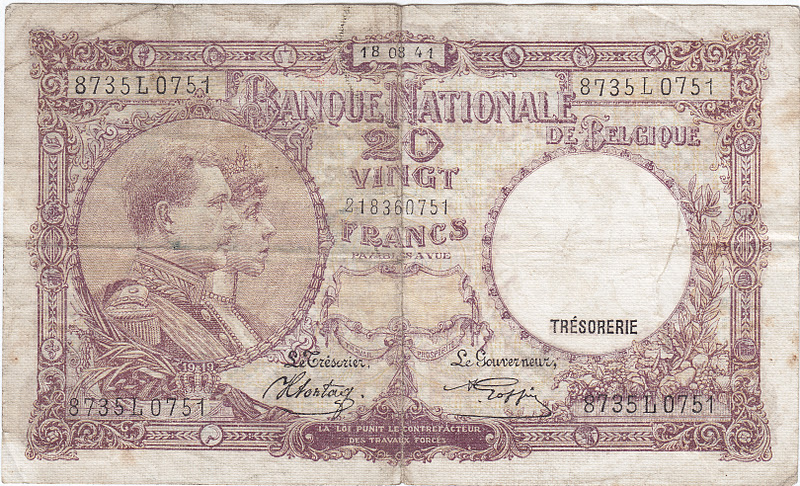
Belgian banknotes King Albert I (part 4)

Let us have a closer look on the King Albert I issues of 1921 - to 1948.


There are 4 types of this banknote :


type 1 (Krause n° 94)   
     -  issued from 1.6.1921 to 10.4.1926
     -  date on top of the note
     -  nothing written in the white circle
     -  2 signature varieties

type 2 (Krause n° 98)   
     -  issued from 14.4.1926 to 27.1.1940
     -  date on top of the note
     -  "Trésorerie" AND "Thesaurie" in the white circle
     -  3 signature varieties

type 3 (Krause n° 111)   
     -  issued from 27.1.1940 to 13.6.1947
     -  date on top of the note
     -  "Trésorerie" on one side  and "Thesaurie"on the other side, in the white circle
     -  4 signature varieties

type 1 (Krause n° 116)  
     -  issued on 1.9.1948
     -  date in left corner on the note
     -  "Trésorerie" on one side  and "Thesaurie"on the other side, in the white circle
     -  4 signature varieties

Type 3 in detail :

20 francs - krause 111 c

We can see the date of issue, on top, in the middle.
There are many printing dates.
Printing dates

Type 3 has dates between 27.1.1940 and 13.6.1947
There are also 4 different signatures.

signature details


Watermark area :

type 1 has no text in this area,
type 2 has the french word : 'trésorerie' at the top, and the dutch word 'thesaurie' at the bottom
type 3 has the french word at the bottom on the front side, the dutch word on the back side
type 4 is similar to type 3

watermark area for type 3

Details :

coat of arms - Brussels

In the left corner, we find the coat of arms of the city of Brussels.

The main image shows the market square of Brussels:


Sunday, October 16, 2011

Belgian banknotes King Albert I (part 3)

Between 1921 and 1927 a 100 belgian franks note was in circulation.
It's similar to the ones shown before (see part 1 and part 2) but the value is only in belgian franks (not in "belgas" as shown earlier).

100 franks (Krause 95) front
nice art deco design
At the back we see the same design as I showed before, but in fact, this note was issued before the one I showed earlier.

100 franks (Krause 95) back
Mark some of the details at the bottom of the note.
This note refers to the city of Liège. (dutch : Luik, german : Luttich).


The abbey of Liège can be found on the left corner at the bottom.


The right image was used years later, on a stamp.
This stamp is subject for another article, but that will be for another time.


see: http://rainbowstampsandcoins.blogspot.com/2011/04/belgian-banknotes-king-albert-i.html

Brazil : 01d Early issues - Dom Pedro II

In 1878, a two coloured stamp was issued.
Again a younger version of the emperor, since the beard appear more colourful then the previous emission.

There was only one stamp of this type in circulation, but the catalogue mentions 2 version, one on normal paper and one on very thin paper.
This last one was found much later, when the stamp was already redrawn from postal use.
Therefore, the 'thin' stamps are only found mint (some even without gum).

300 reis (scott 0078)
I'm skipping some stamps now, but I'll come back on them on my next posting.
First I'm showing the 1883 and 1884 issue, which was the last set of stamps depicting the emperor.

In 1883 two very similar stamps of 100 reis were printed (one in March, one in April).
Scott even mention 3 types of the stamp.
The difference is in the background behind the head of emperor Dom Pedro II.

scott 0090, type I and type II

Type I shows a background of horizontal lines

detail scott 0090 T I
Type II shows a background of diagonal crossed lines

detail scott 0090 T II

Type III shows a plain filled background (no pic)

The local brazilian catalogue doesn't mention this third variation, but in later reprints, in black, a third version indeed is mentionned. Maybe the plate that was used, wasn't very clean at the time of printing, so that the colour filled more or less the full background.
In the black reprint, this 'dirty'plate will be more responsible for the 'filled' background of this third stamp.

Finally, in 1884,  the last stamp depicting the emperor was emitted.
Again it's a 100 reis stamp, in the same, dull pink colour.
Now the emperor is shown a bit older again.

scott 0091

Next time, the stamps of 1881-88.

Saturday, October 15, 2011

Theme : 1st issues : 03 Estonia

Who said that the first stamp of a country is hard to find and always expensive?
Not for Estonia.

Estonia was part of the Russian Empire until the end of the first World War.
It was independent until the start of the second World War, and was occupied by Germany and later on the Sovjet Union, until it regained independency in 1991.

Since the first stamp was printed in 1919, it's not really a difficult stamp to find, and above that, it's not an expensive stamp at all.

The stamp is unperforated and is part of a set of 4.
The second stamp also was emitted with perforation.

Estonia 001 MNH
Estonia 001 cancelled

Thai coins : 01 e - 10 baht commemorative coins

Another set of beautiful thai commemorative 10 baht coins:

Y # 383

The state highway department celebrated its 90th anniversary on April 1, 2002.
The coin shows the current king, Bhimipol (Rama IX), and king Vajiravudh (Rama VI) who was ruling at the time of the inauguration.

department logo
Y 383 front
Y 383 back


Y # 384

Another 90th anniversary that was celebrated in 2002 (BE 2545, is that of the Vajira Hospital in Bangkok;
The name refers to king Rama VI. He is depicted, together with the current king, on the front of the coin.
At the back we see the Hospital logo.

Y 384 front
Y 384 back


Vajira Hospital in Bangkok
Y # 385

Boy scouting is a popular subject to collectors. Both in stamps and coins, the items always have something 'extra'.
On this 2003 coin, one of the most famous boy scouts is depicted.
We see King Rama XI in scout uniform on this 10 baht coin, on the occasion of 20th World Scouting Jamboree. At the back is the Jamboree logo.

Jamboree Emblem

Y 385 back
Y 385 front


Y # 387

last coin for this episode, is for the King's birthday.
King Bhumibol (Rama XI) celebrated his 75th birthday in 2002.

Y 387 front
Y 387 back


HRH King Bhumibol, Rama IX of Thailand