Monday, May 18, 2020

Inflating your collection : 1 German Empire (Weimar Republic) e

Where in 1921, notes from 10 to 1000 RM were in use, in 1922 notes from 100 to 50,000 RM were needed. And this was just the beginning of the hyperinflation.
By October of 1923, prices doubled every 3 - 4 days. Small banknotes, and later even the larger ones became worthless if you didn't spend them the moment you received them.  Every other day, prices were 20% higher than the day before...

In February 1923, a new note is introduced, 100,000 RM
100,000 RM (1923) - Pick 83a and 83c
This note comes in 3 variations: 83a without T next to the image, 83b and 83c have this "T" next to the image. 83b comes with 2 serial numbers (not in the pic), 83c only has one serial number.
Reverse side of 100,000 RM (1923)
A second emission in February 1923, consists of a 10,000; a 20,000 and a 1,000,000 RM note.
The 10,000 RM is a very rare note and was not issued to the public.
The 20,000 RM is very common.
20,000 RM (1923)
For this note again, there are 6 different watermarks possible.
85a : small circles :
85b : G/D in stars :
85e : Greek pattern :

the other 3 possibilities :
The catalogue mentions two different types of serial numbers for the 85a:
two types of 85a
Not only a different lettertype is used, also the size of the lettertype is different and also the letters left, are in a different lettertype.
On top, one of the notes has an asterisk too. (The colour difference is due to the pic, in reality they are similar.
The catalogue does not mention differences in serialnumber in the other subtypes.
In the two examples of the 85b (pic below), there is however a clear difference in size and lettertype (see the different "2's")
two types of 85b ?
compare both "2's"
20,000 RM (1923) reverse
This 2nd series ends with the emission of a 1,000,000 RM note (not yet in my collection).

to be continued ...

Sunday, May 17, 2020

Inflating your collection : 1 German Empire (Weimar Republic) d

By November 1922 (still within the 3rd emission of that year), two 50,000 RM notes are issued.
One comes without underground printing, the other with underprinting.
Pick 79 / 80 without and with underprinting
detail, without and with underprinting
In December of 1922, a fourth set of notes is ready to be issued.
A new 5000 RM note (smaller) is emitted - according to Pick, with 5 different watermarks 
5000 RM - Pick 80
First note (80a) is with watermark E.
Lots of notes have the letters in the watermark hidden behind the heavy printing on the note.
6-pointed star with letter D in the watermark
Other watermarks are G (80b), I (80c), F (80d) and J (80e).
watermarks F, G, I and J
Next to the watermarks, some other differences my attention :
Some notes have one letter behind the serial number, some have two letters.
There is also a difference in lettertype of the 5 and the 7 if you take a closer look.
Note E...O and M...PG have different "5's"
Note S...WO and M...PG have similar "5's", but different "7's"
The "6's" in note H...U and M...PG are slightly different too, and in my opinion, are also the "2's" different:
Finally, another 1000 RM was planned for December 1922, but wasn't issued.
The note was used with an overprint with a higher denomination later.

to be continued...

Saturday, May 16, 2020

Inflating your collection : 1 German Empire (Weimar Republic) c

More about the - relatively cheap - 1000 RM note.
from all possible variation (8), I presented already 3 in my previous post.
76a (E) - 76b (I) - 76c (F) - 76d (D) - 76e (G) - 76f (H) - 76g (J) - 76h (K)
Today, 3 more variations:
1000 RM - 1922
Watermark E (76a) - H (76f) and F (76c)
The two last notes from this series (76g and 76h) are slightly different from the others, as they are printed on a green underground.
top : white underground -  bottom : green underground

The ones with the green underprint, have 2 different possible watermarks (J or K)
watermark K (76h)
green and white underground
to be continued ...

Friday, May 15, 2020

Inflating your collection : 1 German Empire (Weimar Republic) b

In the second half of 1922, newer and higher denominations are being printed (third emission 1922).  Some notes, like the 1000 RM are being replaced for the 3rd time, by smaller notes.
In September 1922, a new 1000 RM is issued, smaller then the previous ones.
German Reich - Pick 76
Although this banknote does not seems that interesting, there is more to discover then you might think. Important here is the watermark.
In the chart below (pic from Pick's catalogue), we see some of the possible watermarks.
This 1000 RM note can have 8 possible watermark variations.
76a (E) - 76b (I) - 76c (F) - 76d (D) - 76e (G) - 76f (H) - 76g (J) - 76h (K)
3 different watermarks: I - D and G
The standard catalogue doesn't mention more differences, but from the notes I have, there are more differences then just the watermark.
5 different types of notes (Pick 75)
The note with watermark D, has a D as serial letter and a purple serial number.
The note with watermark G, has Gd as serial letter and a green serial number, here also an asterisk.
The 3 notes with red serials numbers all have the I watermark (but random serial letters);
the notes above also have 3 styles in serial numbers one with an asterisk, one without and a third one written in a different lettertype.
Pick mentiones watermark I on yellow paper, J and K on greenish paper and the others on white paper.

In this third emission of 1922, two different 5000 RM are issued too.  These notes are quit valuable.

As the value of each notes drops dramatically, the face value keeps increasing and the quality of the printing drops. More and more notes are needed for the population, so printing becomes a non-stop activity of that Reichsbank. To prevent that people need bundles of banknotes to pay basic products, each new series of notes is a multiple of the value of the previous series ...

to be continued ...

Thursday, May 14, 2020

Inflating your collection : 1 German Empire (Weima Republic) a

After the first world war, Germany had to bare the consequences of the war. A new constitution was written in the city of Weimar. Although the country was still the 'German Empire', from the 30's on, the nazis, communists and conservatives referred to this era, as the 'Weimar Republic'.

Between 1922 and 1924, Germany's economy was a mess, there were lots of depts to be paid, and the Germans had to import way more then they could export. Prices started to raise, and the German Reichsmark lost value, day by day.

Before 1922, the German Reich issued banknotes between 10 Reichsmark (RM) and 100 RM.
German Reich Pick n° 67 - 68 front and back
For the 100 RM version, there are notes with 7 digits in the serial number, (1st picture) and 8 digits in the serial number (2nd picture reverse side) - same value.
German Reich Pick n° 69 a and b
In 1922 (1st emission) a 10000 RM is added, issued in 3 versions. (Pick 70, 71 and 72)
2 different sizes
2 different back side designs
Easily said, there are 2 large notes (70 and 71) and 1 small note (72) -  There are also 2 different designs for the back side. Note 70 has the heavily printed back side, notes 71 and 72 the light version.

Later in 1920, 2 different 500 RM notes were issued too. One comes with a similar design as n° 70.
A second one with only printing on the front. (second emission of 1922)
German Reich 74 a and b
74a has a red serial number, and 74b/c a green serial number.
The 74b has 7 digits, where the 74c has 8 digits.

The fact that similar notes (or coins) are being issued in smaler versions then the notes they succeed, is also an indication of the lost of value of a currency.
Lots of countries (except USA and serveral south American countries) issue larger notes according their face value.  Here, larger means 'higher value'.

to be continued ...

Wednesday, May 13, 2020

Inflating your collection : 0 Introduction b

When I was referring to Venezuela, although there is a high inflation, the banknotes alwas had 'reasonable' numbers on the notes. From 2 to 100,000 (100 mil) bolívares fuertes, and a second set from 2 to 500 bolívares soberanos
To prevent an endless number of zeros on the notes, the currency devaluated and 5 zeros were skipped. If not, the second set of notes would have gone from 2(00,000) to 500(00,000) or 5 million bolívares.

If a currency does not devaluate, the number of zeros just add up, and there we encounter a second problem. Not because of the mathematical number, but the written number...
Ten and hundred are the same everywhere in the world. So is thousand and a million, but there it stops.
Where the States name "1,000,000,000" a billion, Europeans talk about a "milliard", as for them, a billion is 1,000,000,000,000... thousand times more.
The origine of this difference lies in the fact that some countries use the 'long scale' and some use the 'short scale'. One thing is for sure, the scientific numbering is the same in both scales.

The relationship between the numeric values and the corresponding names in the two scales:
short scale (multiples of thousands)
long scale (multiples of millions)
In the long scale, there is always a step between each "-illions", ending in "-illiard".

Benefit of the short scale : per multiple of thousand, we add up : million, bi-llion, tri-llion ...
Benefit of the long scale : logic billion is million x million, trillion is million x million x million
and the long scale won't run easily out of names either.

example : US trillion = 1,000,000 x 1,000 x 1,000 or 1,000,000,000,000
European trillion = 1,000,000 x 1,000,000 x 1,000,000 or 1,000,000,000,000,000,000
We will encounter some of those huge numbers in the future posts.

to be continued...

Tuesday, May 12, 2020

Inflating your collection : 0 Introduction a

Imagine, there is only one bakery in town, and 10 possible buyers.
The baker can make 10 birthday cakes, and sell one to each of his customers.
Everyone pleased, everyone feeded - the value of one cake is 1 unit of the currency.

However, if 100 people want to buy a cake, the baker needs to make more cakes.
But maybe he only has one oven, or limited access to flower, milk, butter, staff, place ...
No problem, he can raise his price to 2 units per cake, he knows he will sell anyhow.
One currency-unit, now represents half of a cake, as the full cake costs double.

In normal situations, this is what happens to keep the economy going. There is a raise of prices as time goes by. People will earn more money, to keep up with the prices, prices go up again ...
This is what we call inflation. From a capitalistic point of view, a healty situation.

shoes in 1922
shoes in 2020
As long as prices rise in a moderated way, (let's say 2% per year) there is no problem.
But what if prices double every year (100% inflation) or even faster ...
In that case we talk about hyperinflation.

It happened to Germany after the first World War in 1923, to Greece in 1944, Hungary in 1946, Yougoslavia in 1994 and more recently to Zimbabwe in 2008.
In my post on Venezolan notes I already posted some notes that were subject to hyperinflation.
How bad the situation in Venezuela might be, they don't even reach the top 10 of worst cases...
(https://rainbowstampsandcoins.blogspot.com/2016/01/currency-today-venezuela-01.html)
Venezolan Bolívar
500 bolívares soberanos
to be continued ...

Thursday, May 7, 2020

Tasmanian Devils 01: 1/2 Lake Marion errors i - final

This is my last post on the 1/2 Lake Marion errors.
The fields with (LAKE M)ARION have that many flaws that they deserve special attention.
There are not less than 16 possible flaws in the two fields I5/I6.

Flaws 1.10 and 2.56 are similar, but larger in the second one.
In 1.44, the legs of the A are connected at the bottom.
For flaw 2.60 the bottom line of the frame is not straight, this flaw requires as well the marks, mentionned in the previous post.
All other flaws are small white spots in and around the letters or the surrounding lines.

So far all known flaws to start examining the Lake Marion stamp of Tasmania.
Several stamps have multiple flaws in different areas of the stamp.
To be sure of a stamp's position, sometimes the border frame of the watermark is required too.

Happy hunting ...

Wednesday, May 6, 2020

Tasmanian Devils 01: 1/2 Lake Marion errors h

In today's post, I bring the last quadrant of the 1/2 Lake Marion stamp of Tasmania.
Again here we find numerous flaws, so let's have a closer look.

Similar to my previous posts, I have omitted fields I5, I6, J5 andJ6, as text field on it's own is good for a hugh number of possible flaws.

In row F, we have the value field (F8), where we can discover 3 possible flaws. Two in plate 1 and one in plate 2:
flaws 1.26          -          2.25          -          1.32
The first flaw can be found on stamp 1.26, where there is a white spot in front of the 2 of the value.
Stamp 1.26 has also flaws in quadrant I and III !On the other side of the '2', below de 'd', one of the green lines does not reach the frame (2.25).
Similar is stamp 1.32 has a green line that is broken, before it reaches the frame border. This white spot is lower than position 2.25.

The G-row has several possible flaws.
flaws 1.52          -          1.46          -          1.55
The first can be found in the water (G6) the lines in the water are broken in four places (flaw 1.52).
In the next field, (G7) there is a white spot in the tree (1.46) and in the water part right of that same tree, another white spot indicates position 1.55.

Moving further to the right, there is a white spot within the green part of the ornament (1.15), there is a white spot towards the outer frame (1.25).
flaw 1.15          -          1.25
A bit lower right of the bottom part of the triangular ornament, a white spot within the design (2.14) and a white spot in the border frame (1.53) - field H9
flaw 2.14          -          1.53
Moving to the horizontal triangular frame, (field I7 and I8).
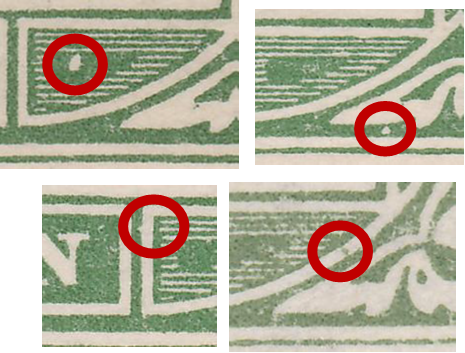
A large white spot indicates flaw 2.60 - for this position, see also below.
Stamp 1.25 has a small spot attached to the triangular ornament on the left side.
On the right side, a green spot between the triangular ornament and the white decoration (1.07) and finally below the white ornament (1.25)
top : flaw 2.60  -  1.25         below : flaw 1.28  -    1.07
Almost identical to flaw 1.25, is flaw 1.59 (smaller white spot):
flaw 1.59
In field J5/J6 the the thick green line below the text frame, shows multiple white small spots, in combination with the ones I presented in quadrant III (flaw 1.17).
flaws in position 1.17
The last part is the white ornament in the right bottom corner (right side).
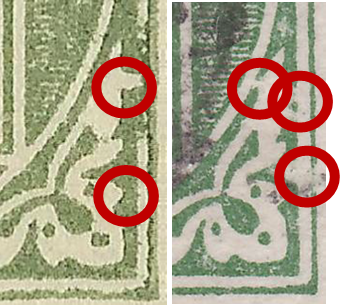
Stamp 2.18 starts off with few white spots on the outer side of the ornament, towards the frame border.  The longer the plate was used, the more pronounced the flaws are.
flaw 2.18
I left two fields out of this overview, as they will be presented in my next post.

to be continued ...