Showing posts with label Asia. Show all posts

Wednesday, December 11, 2013

Russian Republics and more ... 01 A Siberian Federal District - Touva 2a

We can divide Tuva's postal history in 2 periods, the first from 1926 to 1944,
the second one from 1994 to 1995.

A treaty between the Soviet Union and the People's Republic of Mongolia, in 1926, resulted in the independency of Tuva. At least for those two countries as no other country officially recognised Tuva's independency.
No wonder that the first stamp of Tuva, issued in 1926, was in Mongolian language.
(this stamp is NOT in my collection (yet)).
We see on the stamp the buddhist wheel of life, and writings in Mongolian language.
Also the numbers are written in Mongolian.
UPU rules state that the numerals should be written in arabic numerals! 

1st stamp of Tuva - wheel of life


The First Philatelic Period 1926-1944
1926

First Tuvan Stamps (see pic above) 1-10

1927

First Provisional Overprints 11-14

1927

Local Scenes (see below) 15-28


1932

Provisonal Overprints 29-34

1933

Local Provisional Overprints 35-38

1933

Local Prov. Overprints on Tax Stamps 39-40

1934

Tuva Landscapes 41-48

1934-5

First Tuva Airmails 49-58, 59

1935

Tuv Landscapes II 60-66

1936

15th Ann. of Tuva People´s Republic, Postage 77-98

1936

15th Ann. of Tuva People´s Republic, Airmal 99-107

1938

Provisionals 108-113

1939

Provisionals 114-115

1941

Provisionals 116-123

1941

Colour changes 124-128

1942

22nd Ann. of the Tuva People's Republic 131-133

1943

23rd Ann. of the Tuva People's Republic 134-136


Some of the Tuvan stamps, more likely being produced as propaganda
and to raise money then to serve 'postal' purposes.


... to be continued

Sunday, September 15, 2013

Currency Today : Bhutan 04

For the last post on this item, I will show the highest denomination, the banknote of 1000 ngultrum.

I start with the back side of the note:
Similar to the 100 ngultrum note, the picture on the back side of the 1000 ngultrum note, is the dzong of Tashichho.
The picture is similar to, but not exactly the same as the 100-note.
1000 ngultrum - back side
Tashichho Dzong in Thimphu, Buthan
Besides the amazing yellow-orange colour of the banknote, we also see a golden seal in the upper left corner.
By flipping the banknote, the colour shifts from reddish to greenish gold.

colour shifting seal - 1000 ngultrum
full colour seal of Bhutan
golden seal - 1000 ngultrum


At the front we see another seal. This is in gold print and has not colour shift.
The seal of Bhutan is composed of a double diamond-thunderbolt (dorje) placed above a lotus, surmounted by a jewel and framed by two dragons.
The thunderbolt represents the harmony between secular and religious power.
The lotus symbolizes purity; the jewel expresses sovereign power; and the two dragons, male and female, stand for the name of the country which they proclaim with their great voice, the thunder.

1000 ngultrum - front side
On the front side of the note, we see a computer made picture of the king, Jigme Khesar Namgyel Wangchuck.

detail King Jigme K. N. Wangchuck
Interesting is the crown he is wearing.
It is the so called "Raven Crown".
In the previous article (about the 500 ngultrum note) you can see a picture of the first king of Bhutan, wearing a similar type of crown.

Raven Crown - Bhutan
Raven Crown - Bhutan 500 ngultrum note

The Raven Crown today is the official crown worn by the Kings of Bhutan. The Raven is the national bird of Bhutan. The raven is known locally as Jaroq. At one time it was a capital crime to kill a raven in Bhutan.

The hereditary monarchy of the Wangchuk dynasty in the independent Himalayan State of Bhutan was established in 1907. The first king of the Wangchuk dynasty, Sir Ugyen Wangchuck (1862–1926), was a charismatic figure who came to power against a turbulent background of incessant and complex feuding in that chaotic warrior state. He adopted as the unique symbol of his authority a crown surmounted by the head of a raven.
The bird represents a form of "Mahakala", Bhutan's guardian deity. The prototype of the founding monarch's Raven Crown had first been devised as a battle helmet for his father, Jigme Namgyel (1825–81). Known as the Black Regent, he had worn it in bloody struggles against his many rivals within the country and against the British who tried, unsuccessfully, to subdue him.

Hereditary Kings of Bhutan
  • His Majesty Ugyen Wangchuck (1st Druk Gyalpo)
  • His Majesty Jigme Wangchuck (2nd Druk Gyalpo)
  • His Majesty Jigme Dorji Wangchuck (3rd Druk Gyalpo)
  • His Majesty Jigme Singye Wangchuck (4th Druk Gyalpo)
  • His Majesty Jigme Khesar Namgyel Wangchuck (5th Druk Gyalpo)

Saturday, September 14, 2013

Currency Today : Bhutan 03

In this third article on banknotes of Bhutan, I present the 100 and 500 ngultrum notes.

100 ngultrum - front
On the front side of the 100 ngultrum note, we see again the portrait of the former King Jigme Singye Wangchuck (same image as on the 10 ngultrum note).

100 ngultrum - back
The back side of the note, shows an amazing Dzong, the buddhist temple Tashichho Dzong, in the city of Thimphu.
Thimphu is the capital city of Bhutan, situated in the western part of the country.
With more or less  80,000 habitants, it is also the largest city in Bhutan.
the buddhist temple Tashichho Dzong - city of Thimphu
Tashichho Dzong stands on the left side of the Thimphu/Wang chhu river.
In 1641 Zhabdrung built the Tashicho Dzong (Fortress of the auspicious religion) in place of the Dho Ngon (Blue stone) Dzong built by Lama Gyalwa Lhanangpa.
In 1698, the dzong caught fire and was restored.  The dzong caught fire for a second time during the reign of the 16th Desi and 13th Je Khenpo. In 1869, the dzong once again caught fire. His Majesty the Second King initiated the renovation of the Dzong in 1962. Today, Trashichho dzong houses the secretariat, throne room, and offices of the King of Bhutan. The northern section is the Je Khenpo and Central Monk Body’s residence.

500 ngultrum - front
The 500 ngultrum note show a king we haven't seen so far on this set of banknotes. It is King Ugyen Wangchuk (1st King) wearing a Raven Crown.
King Ugyen Wangchuk reigned from December 17, 1907 till August 21, 1926.

500 ngultrum - back
The back side of the note shows the Punkha dzong - the palace of great happiness.
Constructed by Zhabdrung (Shabdrung) Ngawang Namgyal in 1637–38, it is the second oldest and second largest dzong in Bhutan and one of its most majestic structures. The Dzong houses the sacred relics of the southern Drukpa Kagyu school including the Rangjung Kasarpani, and the sacred remains of Zhabdrung Ngawang Namgyal and Terton Padma Lingpa. Punakha Dzong was the administrative centre and the seat of the Government of Bhutan until 1955, when the capital was moved to Thimphu.


Punkha dzong -  city of Punakha
This dzong is located at the confluence of the Pho Chhu (father) and Mo Chhu (mother) rivers in the Punakha–Wangdue valley. Because of the soft climate, Punakha is also called the summer capital of Bhutan.

... to be continued ...

Friday, September 13, 2013

Currency Today : Bhutan 02

After showing the first 3 notes from the current set of Bhutan banknotes,
I continue with the banknotes of 20 and 50 ngultrum.

20 ngultrum - front
50 ngultrum - front
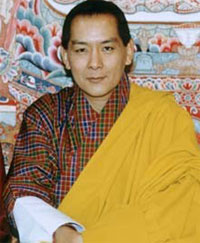
Both front sides show the portrait of King Jigme Khesar Namgyel Wangchuck.
Jigme Khesar Namgyel Wangchuck succeeded his father on the throne on December 14, 2006.

King Jigme Khesar Namgyel Wangchuck
In the middle of the banknote, we find another buddhist symbol : the wheel of Dharma.
After the white conch (on previous notes) we see another of the 8 auspicious symbols:
The golden wheel symbolises the auspiciousness of the turning of the precious wheel of Buddha's doctrine, both in its teachings and realizations, in all realms and at all times, enabling beings to experience the joy of wholesome deeds and liberation.

The back side of both notes, show two palaces:
Punakha Dzong (on the 20 ngultrum note) and Trongsa Dzong (on the 50 ngultrum note)

20 ngultrum - back
50 ngultrum - back
The Trongsa dzong, is the largest dzong in Bhutan.
In Bhutanese (or Dzongkha) 'trongsa' means : the new village.
Trongsa dong - city of Trongsa

... to be continued ...

Thursday, September 12, 2013

Currency Today : Bhutan 01

Today I'm presenting a realy beautiful set of banknotes.
Bhutan is a country in cental Asia, stuck between China in the north, and India to all other sides.
Bhutan doesn't really has diplomatic relations with the Peoples Republic of China, and is more India-orientated.
The country is a bit smaller than The Netherlands, but its population is estimated less then one million people.
Bhutan is hard to visit, as all tourist have to book their holidays through local travel agencies, which cost up to 250 USD / day.
It's a way to avoid mass tourism.
The Bhutan currency 'ngultrum' is exchangable with the Indian rupee 1:1.
"dNgul Tam"  means 'silvercoin' and is divided into 100 "ch(h)etrum(s)"
The banknotes start with  ngultrum ...

The first set of banknotes (series 1974) have serial numbers starting with A (1 ngultrum) to G (500 ngultrum).
In the current set (2006 and renewed more recently), serial numbers start with I (1 ngultrum) to R (1000 ngultrum). - serial numbers with 'O' and 'Q' are omitted.

1 ngultrum - front
1 ngultrum - back
The 1 ngultrum note, shows dragons, and the 5 ngultrum mythical birds.
On the back side of the 1 ngultrum, we see the Simtokha Dzong, and on the back side of the 5 ngultrum, a picture of a house. I couldn't find out if 'Taktsang' (written underneath the picture) refers to a city in Tibet or not.
The Simtokha Dzong is a 'Dzong' - a palace, house of local governors, bhuddist school, place where monks live and pray ...
5 ngultrum - front
5 ngultrum - back
The 10 ngulturm note, shows us a portrait of the former King of Bhutan, HRH King Jigme Singye Wangchuck (reign : July 1972 - December 2006)

 Jigme Singye Wangchuck
10 ngultrum - front
a conch - symbol of good luck
We also see on the front side of the banknote, a conch (shell), one of the 8 symbols of good luck.
This conch can also be found on numerous stamps of the Indian Feudatory States of Cochin,
Travancore and Travancore-Cochin.

The white conch which coils to the right symbolises the deep, far-reaching and melodious sound of the Dharma teachings, which being appropriate to different natures, predispositions and aspirations of disciples, awakens them from the deep slumber of ignorance and urges them to accomplish their own and others' welfare.

Travancore stamp with conch

On the back, a picture of another dzong (palace), this time in Paro.

10 ngultrum - back
... to be continued...

Tuesday, November 22, 2011

Collecting : my collection 02b

Last time, (previous entry) I told about the European part of my collection.
As 'DAVO' albums are quite expensive, and not always available for non-European countries, I chose to make my own albums.
But first my books for my 'cancelled' collection.
I use regular stockbooks for this part of my collection. Again I stick to the colours I mentionned before in my country list. Asia is there shown in yellow, but for the album I don't have sufficient yellow albums of course.
So I use brownish albums.
In the pic below, I only have Iran and Thailand finished so far.
In my 'green' part (Australia and Pacific) I only started my album 'Papua New Guinea'.

Stockbooks - cancelled Asia and Papua
So how about my MNH stamps?
I told you that preprinted albums are (or can be quite expensive).
Making your own album takes more time, but is more fun of course.
There are several websites that offer free, or paid preprinted albums.
With a simple subscription, and a little fee (or free for certain countries), I made my own albums.
They are all in so called 'display books' with transparent pockets.
I chose 'neutral books' and not the coloured version, because not all desired colours were available, and in case one colour gets out of stock, I don't have to renew all album.

I'm still working step by step to those albums, but a little example for my India-collection.
Again, this books are only for my MNH collection (outside Europe):

Display books - India (part 1, 2, 3) - self made cover

Display album inside - Early issues of India
Display album inside - Modern India

Various display albums

Various display albums

Of course, this takes a lot of time, but ... i'm working on it.
the horizontal papers are albums that aren't finished yet...

bottom shelf, in the middle ... to be done...

to be continued ...

Sunday, July 10, 2011

Collecting : My collection 01 b

Of course there aren't only european stamps in this world.
After I completed the list of european states, countries, regions... I searched the internet for all asian countries.
The list was not less impressive.

There might be discussions if a certain number of states should be european countries or asian.
Same for some islands that can be considered in the asian or the oceanic continent.
Pardon me, if your country is (according my list) in the wrong continent. I got my information mainly from the internet.

The colour is yellow in my excel file, but the albums for all asian stamps/coins/banknotes is brownish.
The list starts with a 2 (1 was taken for Europe already).


example :
(0)21001 = Iran
(0)21501 = U.A.E. Abu Dhabi
(0)21502 = U.A.E. Ajman State
(0)22401 = India - as a British colony
(0)22402 = India after independency
(0)22501 = India princial states ...
(0)22601 = India feodal states ...

and so on...