Showing posts with label 1922. Show all posts

Sunday, May 17, 2020

Inflating your collection : 1 German Empire (Weimar Republic) d

By November 1922 (still within the 3rd emission of that year), two 50,000 RM notes are issued.
One comes without underground printing, the other with underprinting.
Pick 79 / 80 without and with underprinting
detail, without and with underprinting
In December of 1922, a fourth set of notes is ready to be issued.
A new 5000 RM note (smaller) is emitted - according to Pick, with 5 different watermarks 
5000 RM - Pick 80
First note (80a) is with watermark E.
Lots of notes have the letters in the watermark hidden behind the heavy printing on the note.
6-pointed star with letter D in the watermark
Other watermarks are G (80b), I (80c), F (80d) and J (80e).
watermarks F, G, I and J
Next to the watermarks, some other differences my attention :
Some notes have one letter behind the serial number, some have two letters.
There is also a difference in lettertype of the 5 and the 7 if you take a closer look.
Note E...O and M...PG have different "5's"
Note S...WO and M...PG have similar "5's", but different "7's"
The "6's" in note H...U and M...PG are slightly different too, and in my opinion, are also the "2's" different:
Finally, another 1000 RM was planned for December 1922, but wasn't issued.
The note was used with an overprint with a higher denomination later.

to be continued...

Saturday, May 16, 2020

Inflating your collection : 1 German Empire (Weimar Republic) c

More about the - relatively cheap - 1000 RM note.
from all possible variation (8), I presented already 3 in my previous post.
76a (E) - 76b (I) - 76c (F) - 76d (D) - 76e (G) - 76f (H) - 76g (J) - 76h (K)
Today, 3 more variations:
1000 RM - 1922
Watermark E (76a) - H (76f) and F (76c)
The two last notes from this series (76g and 76h) are slightly different from the others, as they are printed on a green underground.
top : white underground -  bottom : green underground

The ones with the green underprint, have 2 different possible watermarks (J or K)
watermark K (76h)
green and white underground
to be continued ...

Friday, May 15, 2020

Inflating your collection : 1 German Empire (Weimar Republic) b

In the second half of 1922, newer and higher denominations are being printed (third emission 1922).  Some notes, like the 1000 RM are being replaced for the 3rd time, by smaller notes.
In September 1922, a new 1000 RM is issued, smaller then the previous ones.
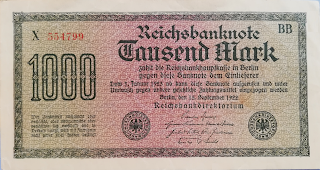
German Reich - Pick 76
Although this banknote does not seems that interesting, there is more to discover then you might think. Important here is the watermark.
In the chart below (pic from Pick's catalogue), we see some of the possible watermarks.
This 1000 RM note can have 8 possible watermark variations.
76a (E) - 76b (I) - 76c (F) - 76d (D) - 76e (G) - 76f (H) - 76g (J) - 76h (K)
3 different watermarks: I - D and G
The standard catalogue doesn't mention more differences, but from the notes I have, there are more differences then just the watermark.
5 different types of notes (Pick 75)
The note with watermark D, has a D as serial letter and a purple serial number.
The note with watermark G, has Gd as serial letter and a green serial number, here also an asterisk.
The 3 notes with red serials numbers all have the I watermark (but random serial letters);
the notes above also have 3 styles in serial numbers one with an asterisk, one without and a third one written in a different lettertype.
Pick mentiones watermark I on yellow paper, J and K on greenish paper and the others on white paper.

In this third emission of 1922, two different 5000 RM are issued too.  These notes are quit valuable.

As the value of each notes drops dramatically, the face value keeps increasing and the quality of the printing drops. More and more notes are needed for the population, so printing becomes a non-stop activity of that Reichsbank. To prevent that people need bundles of banknotes to pay basic products, each new series of notes is a multiple of the value of the previous series ...

to be continued ...

Thursday, May 14, 2020

Inflating your collection : 1 German Empire (Weima Republic) a

After the first world war, Germany had to bare the consequences of the war. A new constitution was written in the city of Weimar. Although the country was still the 'German Empire', from the 30's on, the nazis, communists and conservatives referred to this era, as the 'Weimar Republic'.

Between 1922 and 1924, Germany's economy was a mess, there were lots of depts to be paid, and the Germans had to import way more then they could export. Prices started to raise, and the German Reichsmark lost value, day by day.

Before 1922, the German Reich issued banknotes between 10 Reichsmark (RM) and 100 RM.
German Reich Pick n° 67 - 68 front and back
For the 100 RM version, there are notes with 7 digits in the serial number, (1st picture) and 8 digits in the serial number (2nd picture reverse side) - same value.
German Reich Pick n° 69 a and b
In 1922 (1st emission) a 10000 RM is added, issued in 3 versions. (Pick 70, 71 and 72)
2 different sizes
2 different back side designs
Easily said, there are 2 large notes (70 and 71) and 1 small note (72) -  There are also 2 different designs for the back side. Note 70 has the heavily printed back side, notes 71 and 72 the light version.

Later in 1920, 2 different 500 RM notes were issued too. One comes with a similar design as n° 70.
A second one with only printing on the front. (second emission of 1922)
German Reich 74 a and b
74a has a red serial number, and 74b/c a green serial number.
The 74b has 7 digits, where the 74c has 8 digits.

The fact that similar notes (or coins) are being issued in smaler versions then the notes they succeed, is also an indication of the lost of value of a currency.
Lots of countries (except USA and serveral south American countries) issue larger notes according their face value.  Here, larger means 'higher value'.

to be continued ...